Howard Aero Incorporated - Howard 500
Search Page / Howard 500
$2,500,000
(excl. tax)





About Howard Aero Incorporated - Howard 500
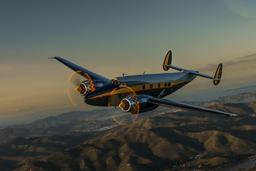
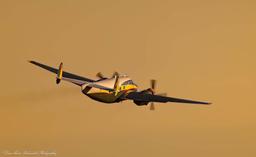
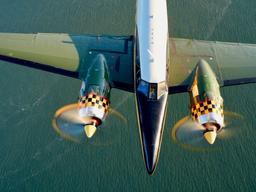
The Howard 500 is a distinguished American executive transport aircraft, notable for its robust design and luxurious amenities, which was produced during the early 1960s by Howard Aero Incorporated. What sets the Howard 500 apart is its revolutionary approach to executive air travel: while it bears a visual resemblance to Lockheed designs like the Lodestar and Ventura, it is, in fact, a substantially new aircraft featuring a completely new fuselage specifically engineered for pressurization. This allowed it to maintain a sea level cabin pressure at altitudes up to 16,000 feet, a leading capability for its era. This particular Howard 500, N500HP, is one of the few surviving examples still actively flying today. It is equipped with powerful Pratt & Whitney R-2800 radial engines, enabling it to cruise at speeds of approximately 350 mph and boast a impressive range of over 2,200 miles with a service ceiling of 35,000 feet. The aircraft is designed to accommodate 10-14 passengers in an executive interior, featuring a spacious cabin, ample baggage capacity, and an onboard toilet, all accessible via a large, low-to-the-ground door. Its heritage as a high-performance, long-range transport makes it a unique and capable aircraft even by modern standards. Durrell U. Howard—known all his life as “Dee”—never became a household name like William Boeing or Donald Douglas, but he was responsible for some of the best and most beautiful aircraft ever built in America. Although his formal education ended at age 15, his gifted mechanical mind took him from working on cars to airline mechanic to opening his own aircraft service shop in his home town of San Antonio, Texas. Eventually he would hold more than 30 patents, design and improve numerous airplanes, invent a practical thrust reverser, and convert a Boeing 747 for the king of Saudi Arabia. The Howard 500 In the 1950s, though, all that was in the future. Howard worked on whatever parked in front of his small shop, but he soon saw an opportunity to create aircraft for corporate executives who needed a fast, comfortable means of traveling to places that trains and airlines didn’t serve. There were thousands of World War II airframes (and even more engines) that might serve, but the transports—C–47s and C–46s—were too big and too slow while ex-bombers, such as the A–26, were plenty fast, but had limited room and were difficult to convert into comfortable traveling machines. All of them were noisy and none of them were pressurized. Howard preferred Lockheeds. It made perfect sense. The PV–1 Ventura and PV–2 Harpoon were fast, roomy, tough, and had exceptional range—during the war the U.S. Navy used them to raid northern Japanese islands from bases in the Aleutian Islands. They were developed from prewar Lockheed aircraft initially designed to serve small airlines or big corporations—exactly the market Howard now had in mind. His decision to acquire and convert Lockheeds essentially completed the circle. Howard had a talent for finding talent—his early employees included Ed Swearingen, Bill Lear Jr., and Bulmaro “Cisco” Alarcon—and the skilled men and women he employed in San Antonio built dozens of modified Venturas. Finally, in 1958, their efforts culminated in the Howard 500. Despite its appearance, the 500 is not a converted Lockheed. Although it uses Lockheed outer wing panels and some other assemblies, it is an entirely different airplane, designed and built by Howard. The fuselage was built in San Antonio. Four feet longer than the Ventura, it was designed for pressurization—fuselage bulkheads are spaced every six inches. The cabin’s big enough for a small garden party or a big poker game. The low tailwheel allows entry though a vault-like door in the rear fuselage, with just a 12-inch step up—no ladders or awkward hatches. The deep belly held loads of baggage, and a loo in the back had running water. To move the airplane Howard chose DC–6 engines: Pratt and Whitney R-2800-CB16/17 radials capable of 2,500 horsepower. The result was an airplane that was smaller than the DC–3 but weighed more, had 1,000 more horsepower, and was almost twice as fast. (AOPA Magazine – May 2019) Pratt & Whitney R-2800-CB-16 588.6 Hrs. SMOH – Left 165 Hrs. SMOH – Right Video: https://youtu.be/F0eB6g0r-30
Plane Details
 Plane NameN/A | ManufacturerN/A |
Model NumberN/A | Year of ManufactureN/A |
Serial NumberN/A | CategoryN/A |
Registration NumberN/A |
Howard Aero Incorporated - Howard 500
$2,500,000 (excl. tax)
Seller Information

Platinum F.
Platinum Fighter Sales
176 Views
Posted on: January 24, 2026